
Latin ballroom
Samba dance, from carnival to ballroom
Samba has a reputation for being the party dance, all feathers and speed. The version you learn in a ballroom is its own thing, and it has one skill at its centre that nobody warns you about: the bounce.
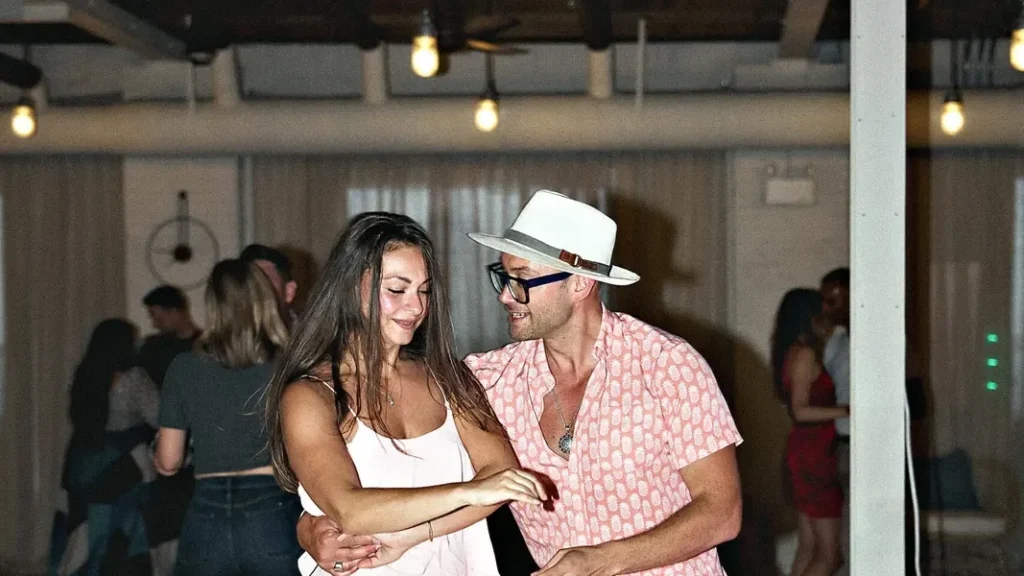
- Rated 4.9 on Google
- Founded by World and British champions
- Adults only
- No partner needed
Two dances share the name
When people search for samba they usually mean one of two things, and they’re learned very differently.
Brazilian samba
The samba of Rio’s carnival is mostly danced on your own: fast, tiny footwork under a moving body. It grew out of Afro-Brazilian music and it’s danced to live percussion in the street.
Ballroom samba
The ballroom version borrows the rhythm and the carnival feel, then adds a partner, a frame and a set of figures that travel around the floor. This is the samba taught in Latin dance classes.
Everything below is about the ballroom one, since that’s what you’ll meet in a partner dance class.
The bounce is the whole trick
Ballroom samba runs on a soft, continuous bounce that comes from the knees and ankles, not from hopping. Done well, it looks effortless and slightly springy. Done by a beginner, it usually looks like someone walking down stairs that aren’t there.
The fix is patience. Coaches tend to teach the bounce on the spot first, to music, before any partnering. Then come the basic figures you’ll hear named in class: whisks, samba walks, the travelling bota fogos and the turning voltas. Each one is the same bounce wearing a different shape.
This is also why samba feels harder than it looks. Your legs are doing a rhythm, your hips are doing something slightly different, and you’re travelling with a partner while it happens. Hip action is a technique, not a gift, and it gets taught step by step like everything else.
Why most people learn it second
Samba is rarely anyone’s first Latin dance, and that’s fine. Most adults at Beach Ballroom start with cha cha or rumba, because those two teach the timing, hip action and connection the rest of the Latin dances lean on. Samba arrives afterward and suddenly makes a lot more sense.
Latin group classes are added to the schedule as groups fill, and you book them with a 5, 10 or 20 class pass, or get them included in a membership. If you haven’t started Latin yet, our guides to cha cha and rumba are the natural first steps.
A warm dance for a cold city
There’s something quietly funny about learning a carnival dance in a Toronto February, with salt stains on your boots by the door. It’s also the best time to do it. Samba is a workout, and an hour of it after work on Queen Street East will leave you warmer than the walk home.
Bring water and a spare top, wear something you can bend your knees in, and change into smooth-soled shoes at the studio. Grippy sneakers fight the bounce.
If samba is the goal
Want samba sooner, or training toward a showcase? Private lessons let a coach build the bounce with you one-on-one, starting at $140 + tax. Not sure where to begin? The $99 consultation ends with a clear plan.