
Swing for people who like pop songs
West Coast Swing: the stretchy one
If your idea of swing is big band and poodle skirts, West Coast Swing will surprise you. It’s smooth, it’s played to the songs already on your phone, and it rewards people who like to improvise.
- Rated 4.9 on Google
- Founded by World and British champions
- Adults only
- No partner needed
Everything happens in a slot
West Coast Swing is danced in a long, narrow lane on the floor called the slot. The follow travels up and down it; the lead mostly stays near the middle and steps out of the way. Once you see it, you can’t unsee it: every pattern is a variation on going away and coming back.
The other defining feeling is stretch. Partners keep a light, elastic tension through the arms, so the connection feels like a rubber band rather than a handshake. At the end of most patterns there’s an anchor, a small settling step where that stretch is at its fullest before the next move begins.
Compared with East Coast Swing, which is bouncier and circular, WCS is smoother and more grounded. Jive is East Coast’s faster, sharper competition cousin; West Coast went the other way, slowing down and stretching out.
Danced to pop, R&B and blues
This is the part that hooks people. West Coast Swing is danced to modern pop, R&B and blues, so the soundtrack is often songs you already know. Slower tracks leave room for playful pauses; quicker ones keep you moving.
Because there’s so much room to improvise, the dance changes with the music in a way that set routines don’t. Followers are encouraged to add their own styling inside the pattern. Plenty of the same R&B turns up in bachata remixes too, so dancers who enjoy one often try bachata next.
The first time a song’s lyric lines up with your anchor step, you’ll understand why people get obsessed.
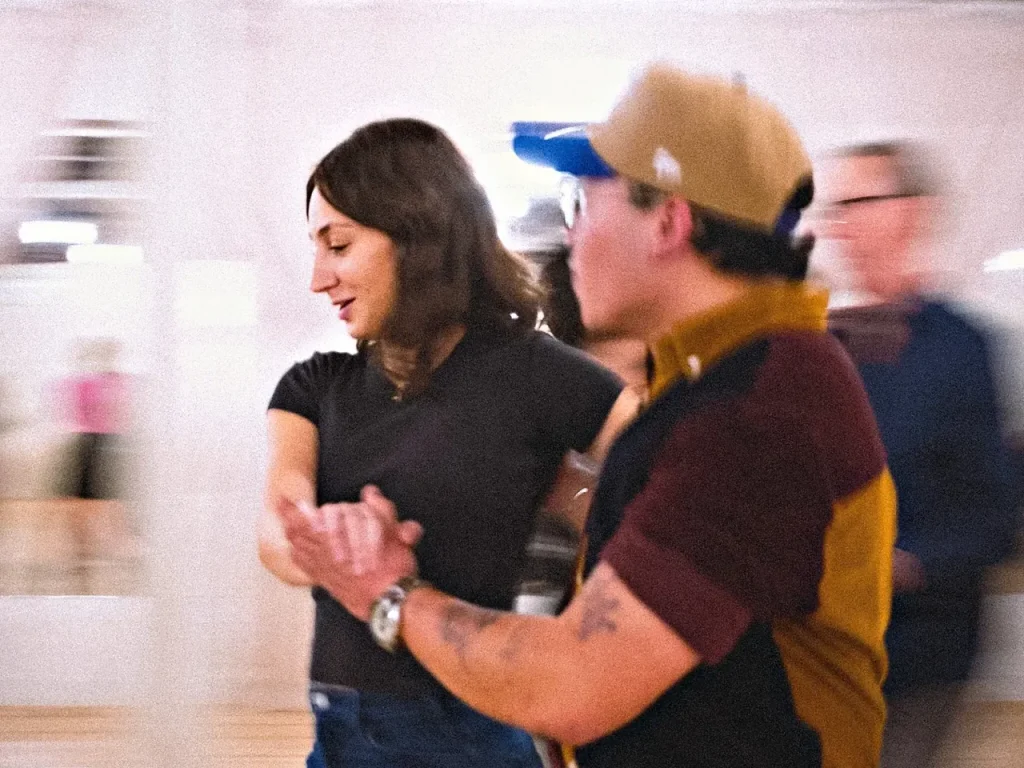
Learning West Coast Swing in Toronto
At Beach Ballroom on Queen Street East, West Coast Swing is taught by Ilinca. Swing group classes are added to the schedule when enough people are interested, so it’s worth checking what’s on or calling to ask when the next one starts. Group classes are booked with a 5, 10 or 20 class pass.
If you don’t want to wait for a group, private lessons can start any week, from $140 + tax, and your coach dances with you. We also teach East Coast Swing, jive and hustle; ask about any of them when you book.
Before your first WCS class
Is West Coast Swing hard to learn?
The basic patterns come reasonably quickly. The connection and the timing of the anchor take longer, which is normal. Most people find it gets more fun as it gets harder.
Can I learn West Coast Swing if I already dance salsa?
Yes, and your partnering experience helps. The footwork and the elastic connection are different, though, so expect a few classes of unlearning.
What should I wear on my feet?
Shoes with a smooth sole so you can slide and turn. In winter, bring them in a bag and change at the studio rather than dancing in wet boots.
Ready to find your slot?
Ask about the next swing group, or start one-on-one this week. If you can’t decide between swing styles, a $99 consultation with a senior coach will help you choose.